
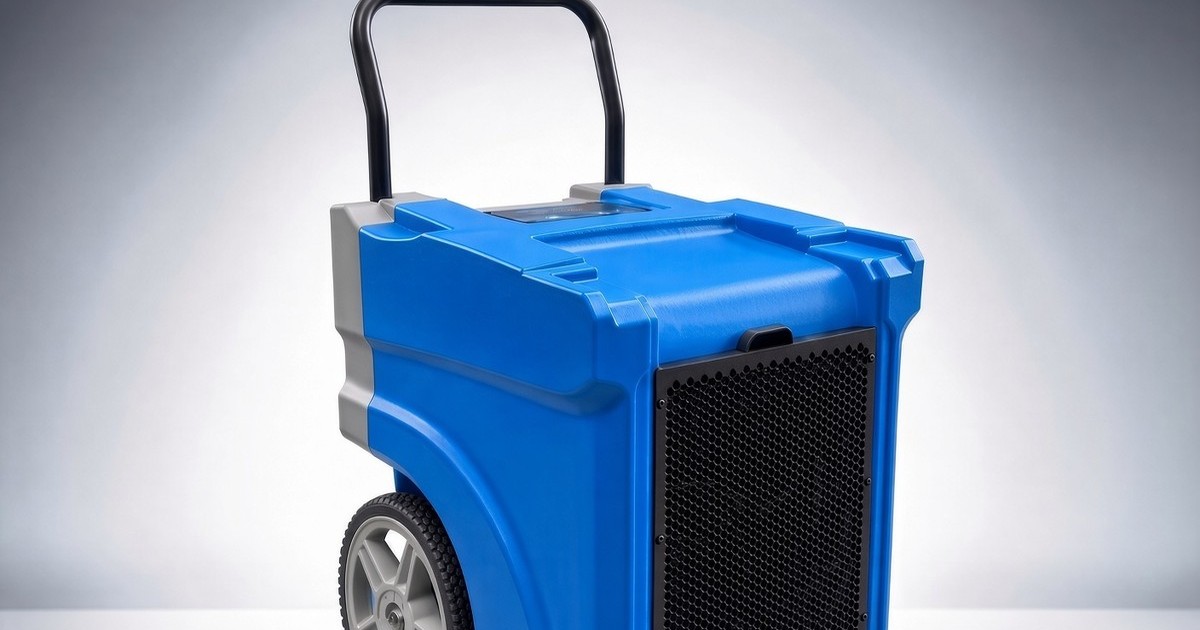
A dehumidifier that cannot pull the grain down, a domestic unit on a Category 2 loss, or a commercial dehumidifier you cannot power next to the air movers costs more in extra days than the machine ever saved.
This is a buying and use guide for Australian restoration, carpet and building professionals. It covers what a dehumidifier does on a water job, why an LGR dehumidifier is the usual restoration dehumidifier, how to read litres-per-day figures, and what to check before you put one on the van.
It is not a drying protocol and it is not a substitute for the moisture map or the insurer’s scope. Match the machine to the space, count the circuit, and treat dehumidification as one part of the dry — not as the whole job.
What a dehumidifier actually is
A dehumidifier is a machine that takes moisture out of the air. It is not an air mover. An air mover speeds evaporation off wet carpet, plaster, timber and other assemblies. The dehumidifier is how you collect that moisture so the room does not just get wetter air.
You will also hear commercial dehumidifier, LGR dehumidifier and restoration dehumidifier used for the same class of kit. What matters is the technology, the published water-removal figure, the current draw and whether the body fits the space.
A hardware-aisle domestic unit is not the same product. A restoration dehumidifier is built to run for days on a wet floor, keep pulling as humidity drops, and pump condensate out instead of emptying a tank every hour.
LGR dehumidifier vs a conventional unit
LGR means low grain refrigerant. Grain is a measure of how much water is still in the air. As a room dries, that number falls. A conventional residential or light-commercial dehumidifier starts to struggle once the air is no longer wet. An LGR dehumidifier is built to keep extracting at those lower grains.
The XPOWER XD-85LH listing describes LGR dehumidification technology for high-efficiency moisture extraction. The DryTrak Mini listing says LGR is designed to keep removing moisture as humidity levels reduce. The Dri-Eaz BD2500 lists advanced LGR technology for superior low-humidity performance.
That is why an LGR dehumidifier is the usual restoration dehumidifier. After extraction you are finishing a room that is already heading down, not drying tropical air. A conventional unit that looks busy on day one and stalls on day three is how you lose the dry. LGR is a class of machine, not a drying-time promise.
Litres per day, AHAM and the nameplate
Litres per day is the figure everyone shops, and the easiest to misuse. A manufacturer can publish a maximum at a hot, wet test point, an AHAM figure at a milder point, or a number with no conditions at all. Compare like with like.
AHAM is the Association of Home Appliance Manufacturers test. The usual published point is 26.7°C and 60% relative humidity — sometimes written 80°F / 60% RH. Saturation or “max” figures are commonly taken at about 32°C and 90% RH. Compare those two numbers separately.
Read the conditions on the sheet you are buying.
- The DryTrak Mini lists AHAM water removal of 50 L/day at 30°C and 80% RH — a wetter, warmer listed point than 26.7°C / 60% RH.
- The XPOWER XD-85LH lists 85 pints (41 L) per day at AHAM (80°F / 27°C, 60% RH) and 145 pints (69 L) per day at saturation (90°F / 32°C, 90% RH). The “85” in the name is the pint figure, not litres.
- The Dri-Eaz BD2500 lists 36 L/day AHAM at 26.7°C and 60% RH, and 63 L/day maximum at 32.2°C and 90% RH.
Do not rank those three on the biggest litre number. If the listing omits the test point, treat the claim as unknown.
Amp draw, drain and the site board
Amp draw decides how many machines share a circuit. The DryTrak Mini is listed at 3.1 A on 240 V (750 W). The XPOWER XD-85LH is listed at 3.7 A on 220–240 V / 50 Hz. The Dri-Eaz BD2500 is listed at 3.4 A on 230 V, 0.78 kW per hour. Add the dehumidifier first, then the air movers. Do not invent a machine count from this page.
Always check the nameplate voltage and current on the unit you receive against the board you will use.
Condensate has to go somewhere. The Mini lists an integrated condensate pump and a continuous drain. The XD-85LH lists an auto purge pump with a 12.2 m drain hose and a 7.6 m power cord. The BD2500 lists automatic pump-out, a 12.2 m drain hose and a 7.6 m power cord. Run the hose to a safe drain.
Airflow is how the machine processes the room. The Mini lists 300 CFM (about 510 CMH). The XD-85LH lists 306 m³/h. The BD2500 lists 272 m³/h maximum.
What to look for when you buy a dehumidifier
Ignore lifestyle packaging and a litre sticker with no test point.
LGR on the label. If it does not state low grain refrigerant, treat it as a conventional unit.
A stated water-removal figure with conditions. Litres per day at a named temperature and RH.
Amp draw and voltage. Confirm the plug and the nameplate for the board you will use. Do not assume 230 V from the brand name.
A pump-out drain. Integrated or auto-purge, plus a hose that reaches a drain. A tank you empty every hour is not van kit.
An operating range that matches the room. The Mini lists 5°C to 38°C. The XD-85LH lists 0.6°C to 40.6°C. The BD2500 lists 1°C to 32°C.
A body you can move. Wheels and a handle, stackable housing if you run a fleet. Listed weight is 30 kg on the BD2500.
Controls, defrost and a filter you can clean. Digital humidity display, auto or adjustable defrost, and a listed filter. A blocked filter is a slow dry.
Three options at Restoration Warehouse
Restoration Warehouse lists three restoration dehumidifiers in this class. They are not interchangeable. Choose on the published litre figure and test point, the current draw, the body and the voltage on the nameplate.
DryTrak Mini Upright LGR Dehumidifier 50L
DryTrak Mini Upright LGR Dehumidifier 50L
Brand DryTrak. SKU DRY-FAM-MUD. LGR dehumidifier. Listed AHAM water removal 50 L/day at 30°C and 80% RH. 240 V, 750 W, 3.1 A. Process airflow 300 CFM. Integrated condensate pump and continuous drain. Digital display with real-time humidity monitoring. Automatic defrost. Rotomoulded housing. Wheels and foldable handle. Operating range 5°C to 38°C, 20–90% RH.
Listed uses include water damage and flood recovery, structural drying, mould-remediation projects, construction drying, carpet and underlay drying support, and drying chambers.
That is the compact upright — the unit you take through a hallway or apartment when a larger body will not fit. The listing is also offered as 1, 5 or 10-unit options. Do not assume a pack price from this page.
XPOWER XD-85LH LGR Dehumidifier
XPOWER XD-85LH LGR Dehumidifier
Model XD-85LH. Commercial LGR dehumidifier with a dual intake system. Listed 85 pints/day (41 L) at AHAM (80°F/27°C, 60% RH) and 145 pints/day (69 L) at saturation (90°F/32°C, 90% RH). 220–240 V / 50 Hz, 3.7 A. Airflow 306 m³/h. Automatic speed control. Washable stainless steel filter. Digital display for humidity and operating time. Auto purge pump with 12.2 m drain hose. 7.6 m power cord. Operating range 0.6°C to 40.6°C. Unit weight 30.5 kg. Unit size 33.3 × 70.6 × 59.5 cm. Stackable up to 3 units high, with wheels and a handle.
That is the mid-size commercial dehumidifier: a higher AHAM figure than the BD2500 at a comparable test point, in a stackable body you can wheel.
Dri-Eaz LGR Dehumidifier BD2500 230 Volt
Dri-Eaz LGR Dehumidifier BD2500 230 Volt
Brand Dri-Eaz. Model BD2500. SKU DRI-EQU-DEH1-0001. Low grain refrigerant. 230 V. Water removal 36 L/day AHAM at 26.7°C and 60% RH; 63 L/day maximum at 32.2°C and 90% RH. 3.4 A, 0.78 kW per hour. Airflow 272 m³/h maximum. Operating range 1°C to 32°C. Dimensions listed 32 × 46 × 55 cm. Weight listed 30 kg. Automatic pump-out, 12.2 m drain hose, 7.6 m power cord, 3-pin plug. Rotomoulded polyethylene housing. Touchpad with inlet and outlet temperature and RH, humidistat 30–90%, stackable body, dual soft-grip carry handles. Safety mark listed CE. Warranty listed 2-year limited, refrigeration 6 years.
Listed uses: water damage restoration; building and construction drying; mould-remediation drying support; bathrooms, kitchens and confined spaces.
That is the compact stackable — the machine the listing describes as fitting where larger dehumidifiers cannot. Do not assume a price or a feature that is not on the listing.
How to use it on site without wasting the dry
Extract first. Standing water is a pump or extractor job. The dehumidifier comes after the puddle is gone.
Close the chamber when the method calls for it. An air mover evaporates. A dehumidifier collects. If you blow wet air out the front door, you are ventilating — a different plan.
Read the meters. The Mini, the XPOWER panel and the BD2500 inlet/outlet display show the machine working. They are not a substitute for a moisture map.
Count the circuit. Add the dehumidifier first. The Mini at 3.1 A, the BD2500 at 3.4 A and the XPOWER at 3.7 A are moderate loads. None of that is a reason to ignore the board.
Put the drain somewhere safe. Auto-purge stops you babysitting a tank — it is not permission to run the hose into a finished hallway. Stay inside the operating range. A machine in defrost is working, not broken, unless it never comes out of it. Clean the filter.
A dehumidifier is not a mould treatment. Mould remediation is a listed use or support use on these machines — it means drying the affected space, not a biocide or a clearance. If the scope is mould, follow the scope.
Put the right dehumidifier on the van
A dehumidifier fails at the same moment you need it — first night after a flood, a unit still wet at handover, a construction dry the painter is waiting on. Treat it as plant, not a box you hire between jobs.
- DryTrak Mini Upright LGR Dehumidifier 50L
- XPOWER XD-85LH LGR Dehumidifier
- Dri-Eaz LGR Dehumidifier BD2500 230 Volt
For current availability, a compact upright versus a stackable body, or a site order, call 07 3568 4925, email sales@restorationwarehouse.com.au, or visit restorationwarehouse.com.au.
