
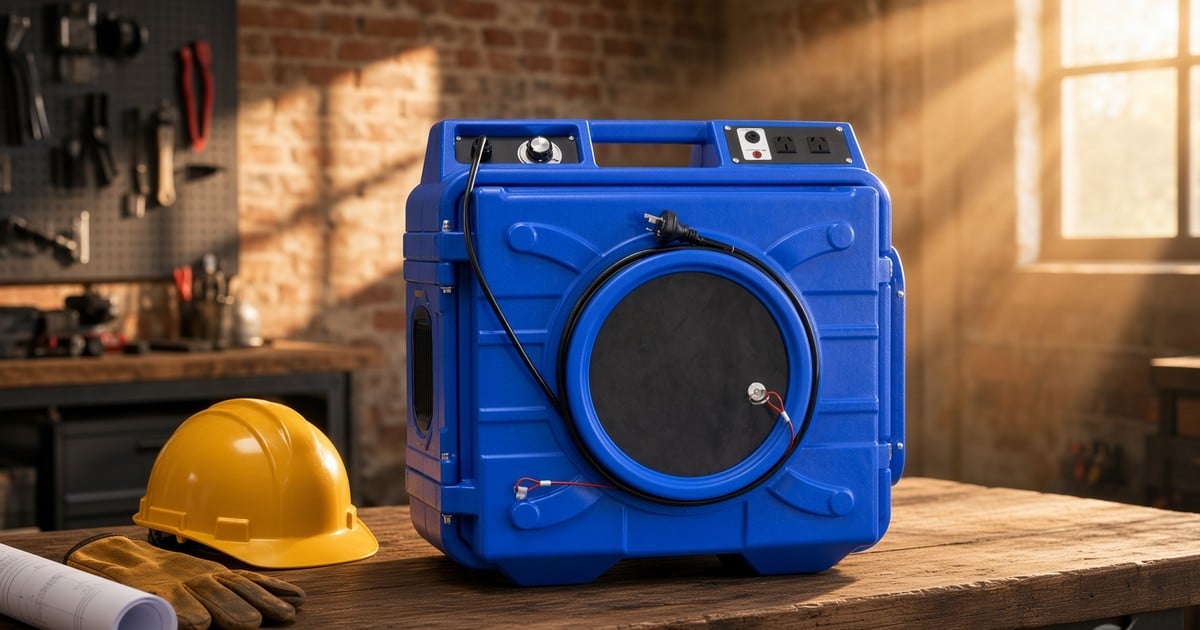
An air scrubber is one of those machines that looks optional until the room is full of dust you just created. A consumer purifier on a mould strip-out, a fan with no HEPA, or a restoration air scrubber you cannot set up as a negative air machine is how you spread the job into the rest of the house.
This is a buying and use guide for Australian restoration, mould and building professionals. It covers what an air scrubber is, when a HEPA air scrubber is the right plant, when the same box has to run as a negative air machine, and what to check before you stock the van.
It is not a remediation protocol and it is not a substitute for containment, the moisture map or the insurer’s scope. Match the machine to the chamber and treat the scrubber as plant — not as the whole job.
What an air scrubber actually is
An air scrubber is a portable filtration unit. It draws air from the surrounding space, pushes it through a filter stack, and either returns that air to the room or ducts it out. The job is airborne contaminants — dust, mould spores, fine particles and, with the right media, odours — not water in the carpet and not moisture in the air.
It is not a dehumidifier. It is not an air mover. An air mover evaporates. An air scrubber filters. Using one as if it were the other is how you dry a room and leave it dirty, or scrub a room and leave it wet.
You will also hear HEPA air scrubber, restoration air scrubber, air filtration system and negative air machine used for the same class of kit. What matters is the filter stack, the airflow, and whether you recirculate or exhaust.
A box fan with a furnace filter taped to the guard is not the same product. A restoration air scrubber is built to run on a dirty site, take a pre-filter and a HEPA, and duct out of a chamber when the scope says so.
A HEPA air scrubber is not automatically a negative air machine
The two search terms are not two machines. They are two setups.
A HEPA air scrubber in recirculation pulls room air through a true HEPA stack and returns the filtered air to the same space. That is the usual layout when the job is dust, spores or particles inside a room you are still working in — demolition, a carpet dry, a fire-clean.
A negative air machine is the same class of unit with the outlet ducted out of the containment. Air leaves the chamber through the filters. Make-up air comes in through controlled gaps. The room sits under negative pressure so dirty air does not leak into the clean side of the house. The DryTrak unit listed later specifies a 150 mm air outlet and lists negative air setups as a use. That is a duct and a sealed chamber — not a different SKU.
Treat it as a setup question: recirculate when you are cleaning the air in the work area; duct out when the scope is containment and you need the chamber negative. Either way you still need a wall. A scrubber in an open hallway just moves filtered air through an unfiltered house.
If the work order is mould remediation, follow the scope. Airflow that keeps a chamber negative is useful. Airflow that pushes affected air into an occupied living room is a problem.
Filtration is the product — not the fan
Buy the stack, then the CFM.
A pre-filter is the first stage. On the DryTrak listing that is a G4 prefilter, supplied installed. It takes the large dust and debris so the HEPA is not doing labourer’s work. A loaded pre-filter is a cheap change. A loaded HEPA is a day and a part.
A HEPA filter is the stage that earns the “HEPA air scrubber” name. True HEPA on the DryTrak listing is specified as 99.97% of particles at 0.3 microns. That is the listed efficiency, not a clearance certificate. If the label does not state HEPA and a particle size, treat the claim as unknown.
Carbon is a different job. Activated carbon is for odours, VOCs and some chemicals — fire and smoke, some sewage, some demolition smells. On the DryTrak unit carbon is optional, not in the as-supplied stack. Do not assume a HEPA-only machine will take a smoke smell down. Do not assume carbon will capture spores.
Do not invent a filter life. The listing notes that the G4 prefilter helps extend HEPA life by taking the coarse load. Change filters to the manufacturer’s instructions and to what you see on site.
CFM, speed and the site board
CFM is cubic feet per minute — how much air the unit is specified to move. The DryTrak air scrubber is listed at a maximum of 800 CFM, with adjustable speed control. That is the manufacturer’s volume figure, not a room-size promise and not an air-changes-per-hour figure you invent from this page.
A bigger CFM number is useful when the chamber is large or you need to pull a containment negative. It is wasted if the inlet is blocked, the filters are loaded, or you cannot power the unit next to the rest of the plant.
Variable speed is how you match the job without always running flat out. Occupied rooms, tight containments and night works are why the speed control is on the housing.
Amp draw still decides how many machines share a circuit. The DryTrak listing describes a low-amp efficiency design. That is not a published amp figure. Add the dehumidifier first, then the air movers, then the scrubber. Read the nameplates.
Daisy chain is listed on this unit — a power outlet on the machine so you are not hunting a socket for every box. Stay inside the rating of the lead, the outlet and the machine.
What to look for when you buy an air scrubber
Ignore lifestyle packaging and imported CFM stickers that do not match the nameplate. Check the features that matter on an Australian site.
A stated HEPA. True HEPA with a particle size and an efficiency. 99.97% at 0.3 microns is the figure on the DryTrak listing. If the sheet does not say it, do not assume it.
A stated airflow. Look for a maximum CFM. If the label does not state a volume, treat it as unknown.
Variable speed. One speed is a compromise. Adjustable airflow is how you run a small bathroom containment and a living-room strip-out on the same van.
A pre-filter in front of the HEPA. G4 or equivalent. Easy filter access is how that change happens on site instead of back at the shed.
Carbon when the job is odour. Optional carbon is the right extra for fire, smoke and VOC work. It is not a default on every water job.
An outlet you can duct. The DryTrak listing specifies a 150 mm air outlet. That is the number you buy duct for.
A body that survives the van. High-impact polymer, stackable, portable, with a listed 5 m cord and daisy chain outlet. Confirm 220–240 V / 50 Hz on the nameplate you are buying.
One option at Restoration Warehouse
Restoration Warehouse stocks a DryTrak HEPA air scrubber in this class. You can run it as recirculation or, with the 150 mm outlet, as part of a negative air setup. It is not an air mover and it is not a dehumidifier.
DryTrak Air Scrubber 800 CFM HEPA Air Filtration System
DryTrak Air Scrubber 800 CFM HEPA Air Filtration System
Brand DryTrak. SKU DRY-FAM-SCR. Air filtration system / air scrubber. Maximum airflow 800 CFM. Motor 1/4 HP. Power supply 220–240 V / 50 Hz. Speed 2,450 RPM, adjustable. Filter system: G4 prefilter + HEPA filter + optional carbon filter. HEPA efficiency 99.97% at 0.3 microns. Noise level ≤65 dB. Cord 5 m, cable 1.5 mm. Air outlet 150 mm. Housing high-impact polymer. Listed dimensions 620 × 400 × 370 mm approx. Supplied with HEPA and G4 prefilter installed, plus a user manual. Portable, stackable, variable speed, quick filter access, daisy chain power outlet.
Listed uses: water damage restoration; mould remediation and containment; fire and smoke damage clean-up; construction and renovation dust control; negative air setups; carpet cleaning and drying; commercial indoor air quality; healthcare, aged care and cleanroom support.
That is the van unit — the HEPA air scrubber you put in the chamber and run on recirculation or duct out for negative air. Available as 1, 5 or 10 air filtration systems. Do not assume a price, an amp draw, a filter life or a stock status from this listing.
How to use it on site without making the job worse
Build the chamber first. A restoration air scrubber in an unsealed room is a fan with expensive filters. Tape, zip walls and a door that actually closes come before the machine.
Decide recirculate or negative before you place it. Recirculate when you are cleaning the air you are working in. Duct the 150 mm outlet out of the containment when the scope is negative air. Do not point an unducted outlet at the clean side of a mould job and call it negative.
Give the inlet air. A unit jammed against a wall or a pile of debris is a blocked machine. Leave space in front of the intake and keep the pre-filter where you can change it.
Do not use it as an air mover. Pointing a scrubber at a wet wall does not dry the wall. Pointing an air mover through a mould chamber without filtration is how you decorate the hallway.
Count the circuit. Low-amp is a design claim, not a published current. Add everything on the lead. Use daisy chain inside the rating.
Change the G4 before you sacrifice the HEPA. Optional carbon goes in when the job is odour or VOC — fire and smoke, not every Category 1 carpet dry. Healthcare, aged care and cleanroom support are listed uses, not a licence to invent a medical clearance. Follow the site procedure.
Put the right air scrubber on the van
An air scrubber fails at the same moment you need it — first hour of a mould strip-out, a demolition dust-off, a fire job where the smell is still in the air. Treat a HEPA air scrubber as plant, not a machine you hire between containments.
For current availability or a site order, call 07 3568 4925, email sales@restorationwarehouse.com.au, or visit restorationwarehouse.com.au.
